mision_1

How to Remove a Company From QuickBooks

how to delete a company in quickbooks desktop

If you’ve used QuickBooks for a while, you need to determine operating profit margin ratios create a new company. Allow me to provide some clarifications about deleting a company file in QuickBooks Online. With preparation and diligence, restarting QuickBooks can pave the way for improved financial management. Focus initially on getting account balances right before entering many transactions. Consider professional assistance if historical records are complex. Learn how to delete your data in QuickBooks Online and start over with new books.

How to Start Over on QuickBooks

Selecting the correct company for deletion is a significant decision, impacting the financial records and historical transactions. Consider exporting any essential data before proceeding with the deletion to safeguard crucial information. By being meticulous in your selection, you can effectively manage your company records in QuickBooks Online. QuickBooks provides a wide range of features, from invoicing and expense tracking to payroll management and financial reporting. With QuickBooks Online, users can access their accounts from any device with an internet connection, while QuickBooks Desktop offers a more traditional software experience.

About cookies Manage cookies

Take time to properly organize and customize the new file’s chart of accounts, items lists, and other settings during initial setup. Leverage the opportunity to streamline workflows and build a foundation for scalable growth. Uninstalling QuickBooks does not delete your company files. When you uninstall QuickBooks, it only removes the application from your computer. Your company file and data remains intact in its original location, usually within your Documents folder.

  1. See articles customized for your product and join our large community of QuickBooks users.
  2. After accessing the company menu, choose the specific company that you intend to delete from QuickBooks Desktop, ensuring that the correct entity is selected for the removal process.
  3. Pay meticulous attention to avoid any errors during this crucial phase.
  4. Focusing on these 4 areas will go a long way towards streamlining your QuickBooks company file and enabling accurate financial management.
  5. Understanding the irreversible nature of this action is vital in making an informed decision.

It’s important to note that once a company is deleted, all its data will be permanently removed, so make sure to back up any necessary information before proceeding with the deletion. Are you considering deleting a company in QuickBooks but unsure how to go about it? Whether you are using QuickBooks Online or QuickBooks Desktop, knowing the proper steps to delete a company is essential.

See articles customized for your product and prepaid rent is what type of account join our large community of QuickBooks users. I don’t understand why Intuit just doesn’t admit this, there is nothing wrong with it. I’m sure they have highly paid PR people who can put this in a nice corporate-sounding way. But instead, we’re supposed to believe it’s just so that we can file our forms later in the year.

Step 4: Confirm the Deletion

Being able to delete your company file on the spot in QBO isn’t available. This is to ensure that you can still view your data whenever you need some information when filing your forms for the year. Should you have many company files, secure a backup copy of them (QBB) and restore them in new folder. It’s crucial for users to back up any necessary records before proceeding with the deletion to avoid any loss of critical financial data. Starting over with QuickBooks can seem daunting, but with some planning and guidance, it is achievable. Here are some best practices to delete your previous company file and restart your accounting.

Condense previous year data
how to delete a company in quickbooks desktop

Both versions allow users to delete accounts, though the steps and process for account deletion differ between the two. Understanding the differences can help businesses choose the right version of QuickBooks that best suits their needs. When you open a company file in QuickBooks, the software gives you a list of available company files to choose from. The more files on the list, the higher the chance you’ll accidentally choose the wrong file and work in the wrong company.

You can also use other supported browsers journal entry for depreciation as an alternative. In addition, it would be best to utilize the Health Checkup Tool. It is used to check multiple aspects of the browser to make sure the application runs seamlessly. On another note, we recommend exporting your QuickBooks Online (QBO) data for your records. You’ll be asked if you want to change your plan, call in, or continue to cancel.

mision_1

Simplify Payroll: The Ultimate Guide to Outsourced Services

payroll outsourced

Outsourcing, on the other hand, means handing over your entire payroll process to another company. They take care of everything from calculations to tax filings, offering expertise and compliance guarantees. If your current system causes frequent mistakes, you may want to consider outsourcing your payroll.

To reduce the risk of a security breach when you outsource, make sure the partner you choose has strict security measures in place. For example, they should comply with data protection laws such as the GDPR. Payroll requires sensitive employee information, and this needs to be protected.

It was easy to manually add an employee or independent contractor by entering their name, email address and other crucial information. The platform offers a checkbox option to invite the added employee or contractor to fill out the rest of the information themselves. Though this process was straightforward, manually entering several people could get tedious for companies with high hiring volumes. The next step prompts you to enter any paid time off that employees took during the pay period. From there, Gusto lets you preview the payroll run in the third step before submitting payroll. Upon submitting, Gusto confirms that you’ve successfully submitted payroll.

  1. We then scored these contenders across 34 metrics in five categories weighted to favor features that small business owners find valuable in a payroll provider.
  2. Follow this guide to learn more about payroll outsourcing and how it can benefit your business.
  3. Paychex is yet another top name in payroll software, support and outsourcing.
  4. Outsourcing gives your business the chance to grow and scale until you’re ready to commit to the expense of in-house employees.

Is outsourcing HR cost-effective?

On Capterra, users give it an average score of 4.9 from over 400 reviews. Common themes in positive reviews include ease of use and satisfaction with customer service. There are plan tiers with OnPay—you pay one base monthly rate and then master budget a flat fee per person per month. The base rate is $40 per month, and then you pay $6 per person per month, so, for a company with 100 employees, OnPay would cost $640 per month.

After all, payroll mistakes can lead to high costs, wasted time, and lost productivity. It may also lead to a hard time complying with the IRS or labor laws, and employees may experience frustration due to long wait times for paychecks. By following these four steps, you can what’s a fair consignment percentage how to negotiate an increase start reaping the benefits of payroll outsourcing and spend your time focusing on other important aspects of your small business. A New York- or San Francisco-based company that keeps payroll in-house, for example, must pay “big city salaries” to attract the right employees for managing payroll, just like the rest of its internal workforce. If many hours of work can instead be assumed by third-party employees somewhere with a lower cost of living, the outsourced functions tend to become cheaper to perform.

How To Use a Payroll Service

payroll outsourced

Adding helpful features such as the IT or workflow modules can get pricey. In addition, there may premium suspense meaning be a lot of features small businesses may not need. Wave doesn’t offer benefits administration, a major drawback, but its recent purchases of companies across the financial sector and its 2019 acquisition by H&R Block promise more capabilities and features to come. Through TriNet’s PEO, you can outsource all of your HR and payroll functions or you can choose which functions you want to outsource and which you’d like to keep in-house.

To determine the best payroll services for small businesses, Forbes Advisor researched the industry and analyzed 23 different companies and their plans. We then scored these contenders across 34 metrics in five categories weighted to favor features that small business owners find valuable in a payroll provider. Here’s a breakdown of the categories we used to rank the providers that made the top of the list. The TriNet mobile app offers convenient features for both employers and their employees. Employers and permissioned personnel can view employee profiles, hire and termination data, benefits and payroll information and access reporting.

Outsourcing payroll: A pros and cons guide

What kind of experience your staff has while working for you can have a major impact on some seemingly unrelated financial outcomes. For example, if turnover is high, you may have additional expenses tied to hiring, onboarding and offboarding staff. Other times, you can actually do something about it, if you can pinpoint what’s driving everyone out of their office chairs. But TriNet’s bread and butter is the HR services, specifically finding, vetting and onboarding talent for their clients.

Payroll Made Easy with Roll by ADP ®

Considering all of those intricacies, it’s little wonder many small businesses choose to focus primarily on core business operations and outsource admin-heavy payroll tasks to an external service provider. TriNet leans hard on its talent acquisition solutions as a differentiating factor. It boasts many of the same offerings as the previous list entries (self-service software, outsourced HR solutions, etc.). And the brand brings significant value to the table in the form of risk mitigation and contractor management. Handing your payroll over to third-party providers means trusting them with sensitive data, including your employees’ details, tax information, and even their attendance records. A reliable payroll partner will provide your employees with self-service portals, which enable them to check their pay stubs, keep an eye on their benefits, and tweak their tax details if applicable.

mision_1

Interest Payable Journal Entry

interest payable

Here’s the journal entry the company passes for interest expense bond issue cost journal entry and interest payable on the balance sheet. At the end of the second month, the company would pass the same entry, and as a result, the interest payable account balance would be $40,000. Let’s say that Rocky Gloves Co. borrowed $500,000 from a bank for business expansion on 1st August 2017. The interest rate was 10% per annum, and they needed to pay the interest expense 20 days after each month ended.

Interest Payable Journal Entry

  1. Debiting an accrued expense and crediting a liability account accurately reflects the financial obligation a company has incurred for interest payments.
  2. The company ABC is required to pay $3,000 of the interest on Jan 1, every year for 5 years and the principal payment is required to make in the total amount at the end of the borrowing period.
  3. It can only show the interest amount that’s unpaid until the reporting date of the balance sheet.
  4. At the end of the month, company needs to record interest payable and interest expense.

For this calculation, the normal mathematical equation to calculate the interests is used. However, there is a series of steps that must be followed to ensure the calculation is done accurately. Interest payable and interest expense are terms that are most often confused in their usage. Though they are meant for serving almost same objectives, there are differences that must be known to firms and individuals using them. In the above example, everything is similar to the previous examples that we have worked out. The only difference in this example is the period when the interest expense has to be paid.

How To Record?

After the second month, the company records the same entry, bringing the interest payable account balance to $10,000. After the third month, the company again records this entry, bringing the total balance in the interest payable account to $15,000. It then pays the interest, which brings the balance in the interest payable account to zero. The balance sheet or journal entry for interest payable enables firms to check and track their financial obligations and be prepared to bear them as and when scheduled. Based on these pieces of information, the financial statements are created. The interest expenses yet to be paid off by the time the balance sheet is prepared are recorded by the firm.

The interest payable account is maintained under the generally accepted accounting principles (GAAP). And also, the interest expense that needs to be paid after December 31st won’t be considered, as we discussed earlier. Now, since the loan was taken on 1st August 2017, the interest expense that would come in the income statement of the year 2017 would be for five months. If the loan were taken on 1st January, then the interest expense for the year would have been for 12 months.

For the past 52 years, Harold Averkamp (CPA, MBA) has worked as an accounting supervisor, manager, consultant, university instructor, and innovator in teaching accounting online. The journal entry for the interest payable should include the amount of interest that is owed and the period in which it was incurred. Let’s say that Company Tilted Inc. has interest incurred of $10,000 for ten months, and the company needs to pay $1000 per month as interest expense ten days after each month eric r lundeen ends.

interest payable

The difference between interest expense and interest payable

On the balance sheet, the company could only show “interest payable” of $1000 ($1000 for December). And the rest of the amount (i.e., $6000) wouldn’t take place on the balance sheet. Interest payable on balance sheet tells firms and keeps them alarmed about the financial obligations they have to fulfill.

Therefore, the company reports $416.67 of interest expense on its January income statement, as well as $416.67 of interest payable on its January balance sheet. Interest Payable is the amount of interest expenses that have been incurred at a point but are yet to be paid. It is one of the forms of liability account that contains information about the interest payments accumulated over time and is scheduled to be paid in future. The current period’s unpaid interest expense that contributes to the interest payable liability is reported in income statement. Interest is not reported under operating expenses section of income statement because it is a charge for borrowed funds (i.e., a financial expense), not an operating expense. It is usually presented in “non-operating or other items section” which typically comes below the operating income.

Find out the company’s interest expense and the interest payable as of 31st December 2017. The most crucial part is that it is entirely different from interest expense. When a company borrows an amount from a financial institution, it must pay an interest expense. However, a company can’t show the entire amount of interest expense on the balance sheet. It can only show the interest amount that’s unpaid until the reporting date of the balance sheet. The company has already paid $3000 as interest expenses for September, October, and November.

mision_1

Quality costs Wikipedia

cost of quality

They have a vested interest in the project and want to know how things are going. Whether it’s a status report, portfolio report or a report on cost or time, you can show them relevant data through reports in multiple formats. Keeping stakeholders happy is a type of quality you can never get enough of. To maintain quality in your project, you need to establish procedures and guidelines.

best practices when thinking about COQ

Within the first year of operation, shortages were reduced by 50% equaling a $200,000 reduction in warranty costs. The project resulted in a positive impact on the bottom line of $140,000 in the first year. Alpha Company has since implemented processes to measure and reduce scrap, improved process controls and introduced new quality metrics throughout the organization. They are now actively measuring and evaluating both the cost of good quality and poor quality. There are multiple options available to the consumer for nearly every product on the market.

  1. Most companies claim to produce or deliver high-quality products and services.
  2. The return merchandise authorization (RMA) functionality helps you manage and track returns, repairs, and replacements your customers have requested.
  3. This is different from the cost of production, which refers to the total amount spent on labour and materials.
  4. Monitoring the cost of quality allows companies to identify inefficiencies within their production lines.
  5. To setup a COQ program that is consistent and accurate, you first must ensure that your Quality Cost Categories are defined, similar to the table above.

The Goal & Benefits of a COQ Program

cost of quality

Since then, the Cost of Quality concept has been continuously improved into a fully developed financial model that has many strategic benefits. This was true when he first said it many years ago & it’s even double entry accounting: what you need to know more true today as industries have become more competitive & complex. Overall, it was suggested through the report that the hospital must optimize resources for providing better services than quality assessment.

Cost of Good Quality (COGQ) vs. Cost of Poor Quality (COPQ)

Within each of the four categories there are numerous possible sources of cost related to good or poor reduce long-term liabilities quality. Some examples of typical sources of Cost of Quality are listed below. It is a fundamental methodology as it allows the business to derive a competitive edge over its peers working in the industry. These costs ensure that problems and root causes that can impact the business are identified very early, and preventive actions can be undertaken.

While these aren’t quantifiable, they affect the company’s profitability. This is an appraisal cost, as in this case, you are checking if the drawings have been made correctly. This will be a prevention cost, as our intention is to establish a system to avoid problems from happening in the first place. Effectively, the hidden factory represents any cost expended to do things right the second time.

Communicate how high your true COQ is

The ultimate goal of a COQ System is to reduce the total cost of quality – which will result in increased profitability & quality for the organization. This end goal is the foundation for all things Continuous Improvement. As we said above, Prevention Costs are those costs or activities that are specifically designed to prevent poor quality in products. In the long term, you should focus on the prevention of defects rather than trying to catch the defects you already made. Until such time that you have processes capable of producing a perfect product, you may have to rely on inspection so you don’t send bad products to your customer. While many organizations claim to produce or deliver high-quality products and services, do they understand that it isn’t really free?

Remember, these calculations differ from one organization to the next. Some businesses calculate the total warranty as a percentage of sales, for example. The cost of quality (also referred to as quality costs) quantifies the total cost of quality-related efforts and issues. In other words, it highlights the financial impact of achieving and not achieving a high standard in the quality of a company’s products and production processes.

If the business does not employ its resources to adhere to quality metrics, it will lose out on its competitive advantage. Furthermore, if the cost of quality is not incorporated, it can severely impact the business’s bottom line. A company can reduce its external failures by asserting control over internal quality measures. When faced with external failures, acting quickly to rebuild customer relations can ease future losses. In order to meet quality expectations, you need to monitor your processes and track metrics in order to catch issues and address them quickly before they negatively impact the project. Our real-time dashboard automatically collects live project data and displays this data in easy-to-read charts and graphs that show everything from time to cost, the workload to project variance.

mision_1

7 Best Online Bookkeeping Services for Small Businesses

bookkeeping services online

In contrast, outsourced bookkeeping and accounting nearly always refers to accountants with an accounting firm who handle your books from their own office. Bookkeeper360 offers a pay-as-you-go plan that costs $125 per hour of on-demand bookkeeping support. It’s an ideal plan for businesses that need minimal monthly support, though if you want more than two hours of help a month, you’ll save more money simply going with a service like inDinero or Bench.co. Virtual bookkeeping services can also save you money through tax preparation services and tax filing, providing peace of mind that you’re 100% compliant with all tax rules.

To put this in perspective, a bookkeeper’s average salary is $44,527. QuickBooks Live Bookkeeping offers online bookkeeping services that connect small businesses with trusted, QuickBooks-certified virtual bookkeepers. Depending on the service you choose, a bookkeeper can give you guidance or take the lead on your bookkeeping. A bookkeeping service can manage your accounting software for you, which takes a lot of administrative work off your to-do list.

Our experts are here to help

bookkeeping services online

Many of the operations are automated in the software, making it easy to get accurate debits and credits entered. If you want your business to save time and money, then you should consider hiring a bookkeeping service. A bookkeeping service can help you stay organized and on top of your finances. FinancePal is best for small businesses that need bookkeeping assistance, including catch-up bookkeeping, entity formation and tax filing. Reviews are not provided or commissioned by the credit card, financing and service companies that appear in this site.

Accurate financials.Total peace of mind.

Jason Ding is a seasoned accountant with over 15 years of progressive experience in senior finance and accounting across multiple industries. Jason holds a BBA from Simon Fraser University and is a designated CPA. Jason’s firm, Notion CPA, is an accounting firm with a business-first focus.

Choosing the right bookkeeping services for your small business will also free up time for you to focus on your company, easing a lot of stress. Bookkeeper is one of the pricier business bookkeeping services on our list, but it comes with many possible add-on services. If you’re looking for a bookkeeping solution you can stick with for the long run, Bookkeeper has most bookkeeping features you could possibly want as an add-on. Possible add-ons include payroll services, individual and business tax returns, and financial performance reporting with key performance indicators.

Ignite Spot Accounting: Best reporting

Online bookkeeping is a good solution for many businesses that can’t afford or don’t need an in-house bookkeeper. Most business owners would rather put their time and energy into helping their company thrive rather than balancing the books and preparing financial reports. But with the abundance of the origins of lehman’s ‘repo 105’ remote bookkeeping companies, you may be wondering how to choose the right service to meet your company’s needs. Here are some of the most important factors to consider when shopping around for an online bookkeeping service.

Online bookkeeping services can save business owners both time and money. However, with hundreds of options, it can be daunting to sort through them all and find the best service for your business. Forbes Advisor analyzed the best bookkeeping services to help you find the right solution quickly and easily. We selected these services based on their service options, pricing, customer service, reputation and more. Some bookkeeping companies charge a flat monthly rate regardless of the size of your business. Others will automatically upgrade your plan to a more expensive one once you hit a specific revenue limit, or you may need to upgrade yourself once you require more advanced features.

  1. It doesn’t provide payroll services or file taxes for you, but Merritt bookkeepers will communicate directly with your CPA to keep them up-to-date on your company’s financials.
  2. The monthly financial reports you receive will allow you to make informed business decisions to support your company’s growth.
  3. Learn how to build, read, and use financial statements for your business so you can make more informed decisions.
  4. Choosing the right bookkeeping services for your small business will also free up time for you to focus on your company, easing a lot of stress.

Bookkeeper360 puts a team of CPAs, advisors, and technology experts at your fingertips to help you better manage your finances. This bookkeeping solution focuses on startups and growth-stage companies. If you invoke the guarantee, QuickBooks will conduct a full n evaluation of the Live bookkeeper’s work. Your bookkeeper can run detailed reports that give you a clear view of your business, so you have the info you need to make informed decisions and feel confident at tax time. Next, your bookkeeper will take on the monthly management of your books. First, a bookkeeper reviews your chart of accounts and past transactions to bring your books up to date.

mision_1

How Do Marketable Securities Impact a Company’s Financial Statements?

marketable securities in cash flow statement

Positive cash flow indicates that a company has more money flowing into the business than out of it over a specified period. This is an ideal situation to be in because having an excess of cash allows the company to reinvest in itself and its shareholders, settle debt payments, and find new ways to grow the business. If, however, a company invests in another company’s equity in order to acquire or control that company, the securities aren’t considered marketable equity securities. There is a direct correlation between an insurance company’s assets and its income, as evidenced by the Prudential income statement and balance sheet. Investing in complex financial companies such as insurance companies requires understanding the business and the different jargon and layout of financial statements. But they are also a source of income for others, such as Microsoft and Apple, in different ways.

Example of Cash Flow From Investing Activities

If an asset has separately identifiable cash flows and if it becomes known that the raw sum of the future cash flows becomes less than the book value, U.S. This account is deemed to be temporary and is included in the calculation of net income and is closed into Retained Earnings. Disclosures to the financial statements describe how the marketable securities have been classified. They also provide further detail as to what kinds of securities are owned by the company and what transactions may have taken place during the fiscal year.

Create a Free Account and Ask Any Financial Question

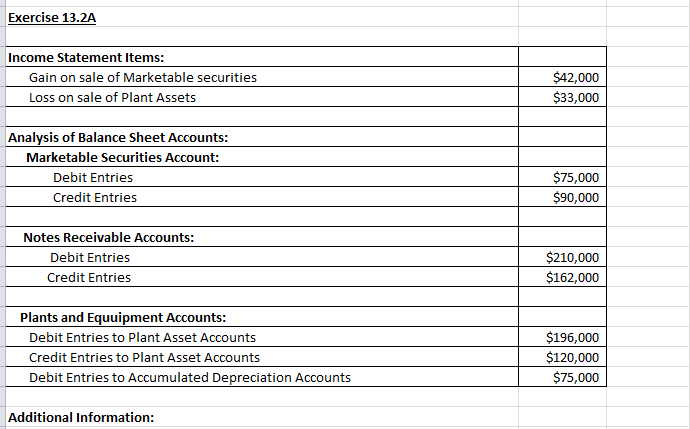
Along with this, it purchased $5 billion in investments and spent $1 billion on acquisitions. The company also realized a positive inflow of $3 billion from the sale of investments. To calculate the cash flow from investing activities, the sum of these items would be added together, to arrive at the annual figure of -$33 billion. Navigating the tax landscape for marketable securities can be complex, yet understanding these implications is crucial for both individual investors and corporations. The tax treatment of marketable securities varies depending on the type of security, the holding period, and the investor’s tax jurisdiction.

The current ratio

The result is the business ended the year with a positive cash flow of $3.5 billion, and total cash of $14.26 billion. In fact, Apple, which has approximately $104 billion in cash, has the bulk of that cash in marketable securities, with $90 billion of those in stocks, 86% of its cash position in marketable equities. Another requirement of marketable security has a strong secondary market, which allows for quick turnarounds of the marketable securities.

marketable securities in cash flow statement

  • This section reconciles the net profit to net cash flow from operating activities by adjusting items on the income statement that are non-cash in nature.
  • The cash flow statement is reported in a straightforward manner, using cash payments and receipts.
  • But they are also a source of income for others, such as Microsoft and Apple, in different ways.
  • However, most companies have a low cash ratio since holding too much cash or investing heavily in marketable securities is not a highly profitable strategy.
  • Add the net cash flows from operating, investing, and financing activities to determine the overall change in cash and cash equivalents for the period.

Various sections of a company’s cash flow statement contribute to the overall change in the company’s cash position. Cash flow from investing activities is one of three primary categories, along with operating and financing, in the cash flow statement. For the year, the company spent $30 billion on capital expenditures, of which the majority were fixed assets.

Cash Flow From Investing Activities FAQs

Cash flow statements are one of the most critical financial documents that an organization prepares, offering valuable insight into the health of the business. By learning how to read a cash flow statement and other financial documents, you can acquire the financial accounting skills needed to make smarter business and investment decisions, regardless of your position. Marketable debt securities are held as short-term investments and are expected to be sold within one year.

Unfortunately, these companies will not have amazing ideas to plug the cash into a space to create outstanding returns. In the meantime, while looking for those opportunities, earning extra income on the spare cash makes sense. For further information regarding the net investment income, we look in the notes for Prudential under the investments note, and we find the breakdown by the security of the earnings. First, the company has far more investments than Microsoft, and as an insurance company, Prudential invests in various different-length assets to match the insurance premiums they collect.

Negative cash flow should not automatically raise a red flag without further analysis. Poor cash flow is sometimes the result of a company’s decision to expand its business at a certain point in time, which would be a good thing for the future. Another important function of the cash flow statement is that it helps a business maintain an optimum cash balance. The cash flow statement presents a good overview of the company’s spending because it captures all the cash that comes in and goes out. Using this method, cash flow is calculated through modifying the net income by adding or subtracting differences that result from non-cash transactions.

The cash flow statement measures the performance of a company over a period of time. As noted above, the CFS can be derived from the income statement and the balance sheet. Net earnings from the income statement are the figure from which the information on the CFS is deduced.

They are unrealized because they have not been sold as yet so their value can still change. They are listed at their current market value as they are under the assets section of free file your income tax return the balance sheet. The manner in which a company reports the changes in the market price of these securities vary, but it affects several parts of the financial statements.

mision_1

Journal Entries to Issue Stock Financial Accounting

journal entry issue common stock

We have now reached December, and the second and final call for class A shares is now coming due. We would repeat the journal entries we created for the first call. So for completeness of the example, the following journal entries would be made by ABC’s accounts team. The debit to the bank account reflects the $400,000 ABC now has from its first call on the class A shares. And the credit to the call account can now be closed as this money is no longer due from shareholders. As stated in the prospectus, the first call of 20 per cent is due from the Class A shareholders by September 30.

journal entry issue common stock

3: Issuing Stock for Cash

When stock is repurchased for retirement, the stock must beremoved from the accounts so that it is not reported on the balancesheet. The balance sheet will appear as if the stock was neverissued in the first place. Chad and Rick have successfully incorporated La Cantina and areready to issue common stock to themselves and the newly recruitedinvestors. Thecorporate charter of the corporation indicates that the par valueof its common stock is $1.50 per share. When stock is sold toinvestors, it is very rarely sold at par value. Stock with no par value that has beenassigned a stated value is treated very similarly to stock with apar value.

What are common shares?

Making the right entries on your books is crucial if your business offers equity to investors. The most common form of a stock split is 2-for-1 or 3-for-1, it means one share will be split into 2 or 3 share while the price of two or three share equal to one share before split. And as we know before, 5 per cent of this is the par value, and the remaining 95 per cent is the additional paid-in capital or premium the shareholders are paying above par value. The first debit entry takes the $400,000 in application money out of the application account. If then splits this across the Class A Share Capital account, being the allotted money. Then theClass A Additional Paid-in Capital account, as we calculated above.

Common Stock Issued for Non-Cash Exchange

When a company issues new common shares from treasury, it means that the company is creating and selling new shares that have not previously been outstanding. Treasury shares are authorized but not currently owned by anyone, so they are effectively “new” shares that the company is creating and selling to raise capital. Hence, we may come across the circumstance in which the common stock has no par value (e.i., no par value registered on the stock certificate). In this case, when we issue the common stock, we will need to record the entire amount of cash received to the common stock account without additional paid-in capital involved.

These features include the right to receive dividends and voting rights. Usually, the accounting for the issuance of a common stock involves three accounts. These include compensation, share capital and share premium accounts. For that, it is crucial to separate the par value of shares from the total finance received. The journal entries for the issuance of common stock impact three accounts. The first involves the debit side, which usually includes the account to record the compensation.

  • It excludes the share that the company buyback from the market.
  • However, states do allow the authorization to be raised if necessary.
  • In each country, there are different laws and regulations that govern how shares can be traded and owned.
  • This means that the stock is issued without assigning a stated value.

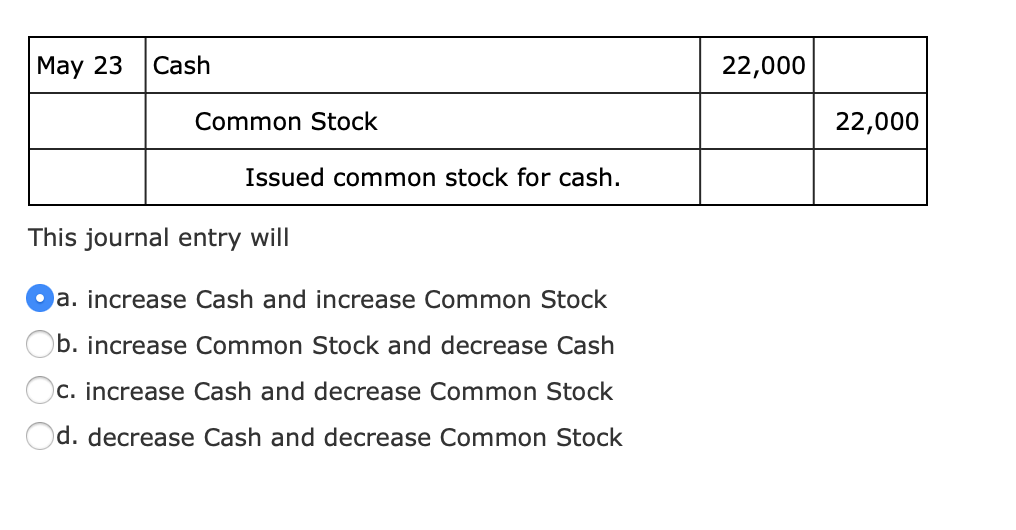
Assuming that the company XYZ still has a $100,000 outstanding balance of the additional paid-in capital account on the balance sheet before the issuance of these 10,000 shares of common stock. In this journal entry, both assets and equity increase by $20,000. Also, there is no additional paid-in capital as the company issues the stock at the par value. The company issues common stock for cash and the issue amount is more than the par value.

In the previous article, we covered the cost of comm stock equity calculation. In this article, we cover how to account for the issuance of common stock. This invoice for a freelance designer ranges from the journal entry for issuance of common stock of all types from par value stock to no par value stock as well as stock for non-cash assets.

However, the share capital account only holds the par value for the issued shares. Furthermore, this account doesn’t necessarily include the finance received from the issuance of shares. Selling common shares to investors is a common method for companies to raise capital.

This contrasts with issuing par value shares or shares with a stated value. In some states, the entire amount received for shares without par or stated value is the amount of legal capital. The legal capital in this example would then be equal to $ 250,000. The legal capital in this example would then be equal to $ 250,000. When it issues no-par stock with a stated value, a company carries the shares in the capital stock account at the stated value.

Common stock forms the basic ownership units of most corporations. The rights of the holders of common stock shares are normally set by state law but include voting for a board of directors to oversee current operations and future plans. Common stock usually has a par value although the meaning of this number has faded in importance over the decades. Upon issuance, common stock is recorded at par value with any amount received above that figure reported in an account such as capital in excess of par value. If issued for an asset or service instead of cash, the recording is based on the fair value of the shares given up. However, if that value is not available, the fair value of the asset or service is used.

mision_1

3 7: Preparing a Trial Balance Business LibreTexts

adjusted trial balance order

As the holiday season approaches, managing cash flow effectively becomes critical for business owners. We will also introduce a fast and secure global payment solution, Wise Business to will help cut the cost on your international payments and provide smart solutions to your financial transactions. Financial statements give a glimpse into the operations of acompany, and investors, lenders, owners, and others rely on theaccuracy of this information when making future investing, lending,and growth decisions. When one of these statements is inaccurate,the financial implications are great. Searching for and fixing these errors is called making correcting entries.

adjusted trial balance order

How does an adjusted trial balance get turned into financial statements?

adjusted trial balance order

However, it is the source document if you are manually compiling financial statements. In the latter case, the adjusted trial balance is critically important – financial statements cannot be adjusted trial balance order constructed without it. Using Paul’s unadjusted trial balance and his adjusted journal entries, we can prepare the adjusted trial balance. Note that only active accounts that will appear on the financial statements must to be listed on the trial balance. If an account has a zero balance, there is no need to list it on the trial balance. Both ways are useful depending on the site of the company and chart of accounts being used.

4 Use the Ledger Balances to Prepare an Adjusted Trial Balance

adjusted trial balance order

An adjusted trial balance is prepared by creating a series of journal entries that are designed to account for any transactions that have not yet been completed. An adjusted trial balance is an internal document that summarizes all of the current balances available in general ledger accounting. The adjusted trial balance is prepared to show updated balances after adjusting entries have been made. An adjusted trial balance is a listing of all company accounts that will appear on the financial statements after year-end adjusting journal entries have been made. To prove the quality of the total debit and credit balances, accountants prepare an adjusted trial balance.

  • These credit balances would transfer to the credit column on the adjusted trial balance.
  • An unadjusted trial balance is what you get when you calculate account balances for each individual account in your books over a particular period of time.
  • This trial balance is prepared after taking into account all the adjusting entries prepared in the previous step of the accounting cycle.
  • We’re firm believers in the Golden Rule, which is why editorial opinions are ours alone and have not been previously reviewed, approved, or endorsed by included advertisers.

How to Prepare a Trial Balance in 5 Steps

adjusted trial balance order

Adjusted Trial Balance refers to the general ledger balances reflecting adjustments, which include accrued expenditure and non-cash expenses. The list and the balances of the company’s accounts are presented after the adjusting journal entries are made at https://www.facebook.com/BooksTimeInc/ the year-end. Those balances are then reported on respective financial statements. Once all of the adjusting entries have been posted to the general ledger, we are ready to start working on preparing the adjusted trial balance.

adjusted trial balance order

The accounts of a Balance Sheet using IFRS mightappear as shown here. An income statement shows the organization’s financialperformance for a given period of time. When preparing an incomestatement, revenues will always come before expenses in thepresentation. For Printing Plus, the following is its January 2019Income Statement. Applying all of these adjusting entries turns https://www.bookstime.com/articles/accounting-for-research-and-development your unadjusted trial balance into an adjusted trial balance.